
Historical epic films in the Philippines have been a good platform of revisiting the past that shapes our present and foretell our future as a nation. From the depiction of life of the first hero of the Philippines in Lamberto Avellana’s Lapu-Lapu (1955); biography of the country’s national hero in Marilou Diaz-Abaya’s Jose Rizal (1998); to the life of Katipunan revolutionary in Enzo William’s Bonifacio: Ang Unang Pangulo (2014); and various films like Raymond Red’s Sakay (1993), Carlo J. Caparas’ Tirad Pass: The Story of Gen. Gregorio del Pilar (1997), and Mark Meily’s El Presidente (2012), which all of them highlight the patriotism and heroism of the Filipinos that can be traced back since the era of colonialism and political imperialism in the country.
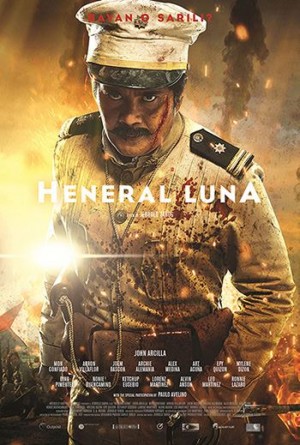
For this year, local cinema has set its foot forward to rekindle the vigorous passion in pursuance of freedom of the nation through Jerrold Tarog’s Heneral Luna (2015) zealously portrayed by John Arcilla from the script written by E.A. Rocha and Henry Hunt Francia. The film is a documentary account to the life and death of General Antonio Luna (1866-1899) who played a pivotal role in the Philippine-American war set during the transition period of Spanish colonization to American political interest to the Philippines in the latter part of 19th century.
Told by the perspective of fictional character Joven Hernando (Aaron Villaflor), a young journalist who interviews the general as he prepares for battle, the story revolves around the deep aspiration of Luna to take pre-emptive strike on the well-equipped and well-experienced Americans while their full forces have not yet landed in Manila. Contradicted by some fellow prominent Filipino political figures like Felipe Buencamino (Nonie Buencamino) and Pedro Paterno (Leo Martinez) who both favor the pro-American sentiments, Luna is upsettingly disturbed by the lack of support of the revolutionary government headed by President Emilio Aguinaldo (Mon Confiado) who himself believes that Americans are here as liberators who want to help the revolutionaries win against the colonizers. Determined as he is, General Luna strives hard to rally his troops to fight against the white men despite all the adversaries.
All historians and biographers of Luna would have agreed that the general is undoubtedly one of the most admired heroes as an educated man with genuine prowess in military science and guerilla warfare that could have been a great advantage to the country. His great desire to unite and discipline the troops in different regions resonates with his fiery personality and pride that would bring him to his untimely death when a pack of presidential guards assassinated him.
When film critic Oggs Cruz from Rappler reviews this film, he states that Tarog treats Luna “with enough respect to release him from being just an object of this victor’s history we have been blindly celebrating throughout the years.” He also adds that Tarog “makes him human, drawing him with virtues as well as warts, and in so doing, creates an essay of everything that is wrong in our nationhood.”
Most of the historical films produced in the Philippines usually portray our heroes as an all-perfect and almost-god idols whom all aspects of life contribute to his strengths as definite answers to our outcry for freedom. As Tarog focuses on a small unit of the story that generally reflects the condition of the nation in a particular period, he successfully depicts Luna as a human being with his own set of intelligence and skills embellished with weaknesses and flaws that make him more unique and unconscious with his heroism in the making. Humanizing the hero is one of the elements of the film that makes it stand out the rest of its contemporaries.
Poetic and lyrical as intended to be, Heneral Luna is a literature for film that uses the device of allegory to deliver the subliminal text of its imagery and narrative powerfully to its viewers in relation to current situations that we experience as a country. It is no secret in history of the Philippines that betrayal and greed are the main reasons that attributed to the fall of the nation up to the present day. Tristan Zinampan of Film Police Reviews vividly observes that “the real focus here is the tension, the inner turmoil, that brewed in the ranks of our so-called Filipino founding fathers. Heneral Luna is a tale of how a dissenting voice can get swept away and ultimately perish under a wave of egos and personal interest.”
John Arcilla’s performance as Luna is excellent. When Arcilla wears the signature moustache of the general dignified with a high-official military uniform, he already captures its near perfect resemblance to Luna. You can easily sense the different personalities of Luna on how Arcilla delivers his lines conveyed with gestures and nuances in accordance with the situations. It is supported by equally exemplary portrayal of other historical figures by ensemble cast.
Technically, Heneral Luna is a film that proudly wears a laurel of achievement as a cinematic entity with mastery on its craft. Pong Ignacio’s cinematography is obviously inspired by the color of Spoliarium, a world famous painting by Juan Luna that predictably mirrors the unfortunate destiny of his brother Antonio. From its breathtaking areal shots that provide a Hollywood-feel, to the visual spectacle of every scene caressed by lights and shadows, it is indeed well executed. There are times that its exterior settings are limitedly suggestive to understandably hide the marks of modernism of the locations. Its milieu blends to the accuracy of the production design from small buttons of military wardrobe to the historical settings of the film. And even the musical score, a credit that can also be given to the director who himself composed it, adds to the poeticism of the film.
Philbert Ortiz Dy appreciates its excellence in totality when he agrees that “this film triumphs in capturing the spirit of its subject, the whole enterprise fueled with a heady mix of rage, irreverence and a genuine love of country. It is everything that an Antonio Luna biopic should be.”
Heneral Luna is an essay that bravely lifts up the curtain of truth to allegorically show how this country, where freedom was passionately and courageously fought for against foreign invaders in the past, is still tied up with chains of social cancers to deny its true sovereignty. The Filipino race on the other hand is challenged by the film to slow down a little and take a look on himself once in a while to contemplate with what General Antonio Luna asks his co-patriots, “bayan o sarili?”

