
Each one of us is intelligent in our own way.
This is the reason why I personally advocate Multiple Intelligences. Howard Gardner, the proponent of the Theory of Multiple Intelligences, proposed eight different intelligences namely:
- Bodily-kinesthetic intelligence
- Interpersonal intelligence
- Intrapersonal intelligence
- Logical-mathematical intelligence
- Musical intelligence
- Naturalistic intelligence
- Verbal-linguistic intelligence
- Visual-spatial intelligence
As an experienced educator in a university, I always meet different kinds of students who exhibit their diverse skills and abilities, either natural or learned.
I personally know a number of students who are excellent in oral recitation and presentation which involves verbal-linguistic intelligence but when the task requires proficiency in images and pictures (which comes from visual-spatial intelligence), they take them as an extra challenge to accomplish.
But there are students who can easily produce creative and aesthetically pleasing media productions as a result of their visual-spatial intelligence but I cannot expect them to be adept at a task that needs logical-mathematical intelligence.
There are many other intelligences out there if we will just be very observant to individuals.
Everyone is a genius.
Intelligence is diverse.
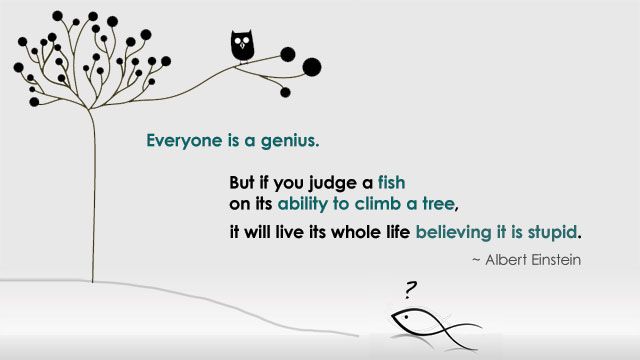
Such perspective may impact the broader aspects of education practices and processes. It may challenge our conventional ways of objective standardization of activities, tools/materials, and assessments for our students without considering their multiple intelligences.
Recognizing the strengths of the students first can possibly be one of the recommendations to also improve the learning goals and the processes on how to arrive at these goals.
At the end of the day, we live in a world full of diversities. That also includes intelligence. Our task is to discover and develop that intelligence to extract its potential for the greater good of the world.
Blog entry for Module 2 | EDS 103: Theories of Learning | UPOU

